
Categories
Neighborhood Guides, Relocation, Things to doPublished September 9, 2026
What Are the Most Walkable Neighborhoods in Richmond, VA?

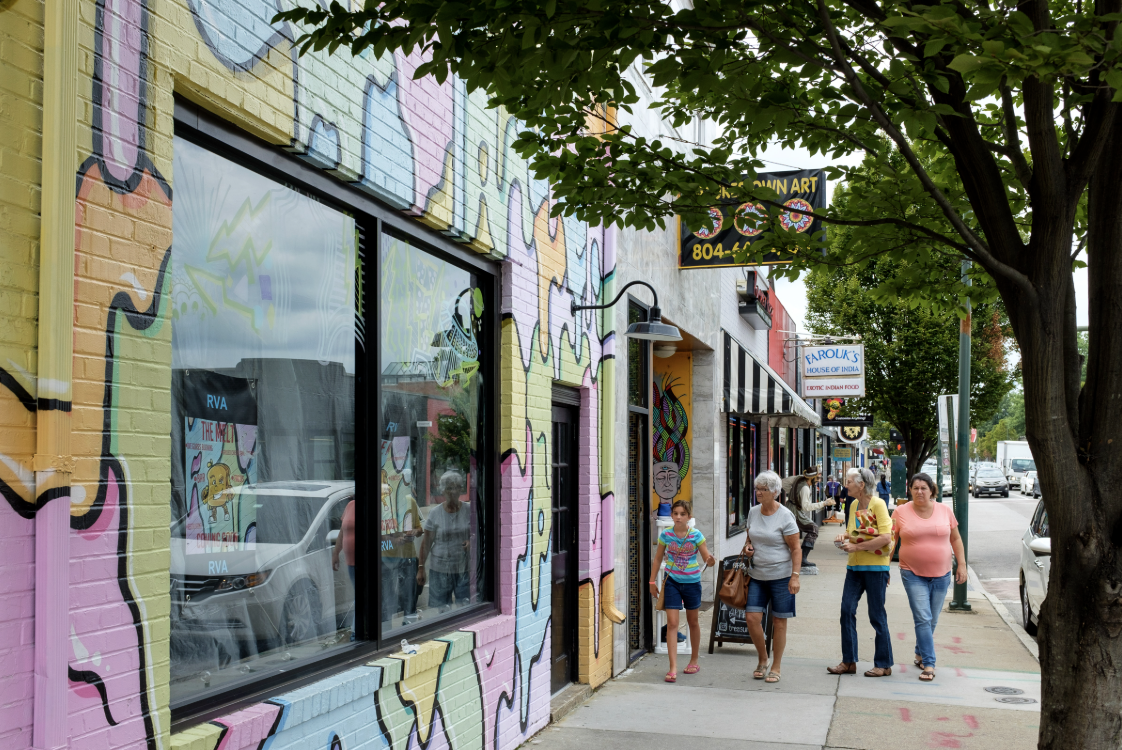
If “I want to be able to walk places” is somewhere near the top of your Richmond home search wish list, we have one follow-up question:
Walk to what?
Because Richmond has some genuinely walkable neighborhoods, but they aren't all walkable in the same way.
Maybe your dream Saturday starts with walking to coffee, wandering through a few shops, grabbing lunch, and heading home without ever looking for your car keys. Maybe you'd rather walk the dog under big trees every morning and have a neighborhood restaurant or two close enough for an impromptu dinner. Or maybe “walkable” means you want groceries, restaurants, parks, coffee, and everyday errands all within reach.
Those are three different versions of walkability, and they might lead you to three different Richmond neighborhoods.
So instead of simply ranking neighborhoods by a number, let's talk about what it actually feels like to live in them.
The Quick Answer: What Are Richmond's Most Walkable Neighborhoods?
If you're looking for a Richmond neighborhood where walking can genuinely become part of everyday life, The Fan, Carytown, the Museum District, Church Hill, Jackson Ward, and parts of Scott's Addition should all be on your radar.
But the right one depends on what you want waiting outside your front door.
The Fan: The “I Could Leave My Car Parked All Weekend” Pick
If someone tells us walkability is one of their absolute must-haves, The Fan is an obvious place to start.
Its street grid puts restaurants, neighborhood markets, coffee shops, parks, bars, and locally owned businesses throughout the neighborhood rather than concentrating everything in one shopping center. Cary Street, Main Street, Grove Avenue, and the surrounding commercial pockets give you plenty of reasons to head out on foot.
The housing is part of the experience too. Historic rowhouses, grand old homes, porches, mature trees, pocket parks, and sidewalks make walking feel less like transportation and more like part of living here.
The tradeoff: that urban convenience comes with urban realities. Parking can require patience, outdoor space is often smaller, and historic homes may come with considerably more personality, and maintenance, than newer construction.
Ruckart Quick Take: If your definition of walkable is “I want to decide where we're having dinner while we're already walking there,” The Fan is hard to beat.
Carytown: The “Give Me Something to Do” Pick
Carytown is probably Richmond's easiest example of walkability to explain because you can see it immediately.
Cary Street gives you block after block of restaurants, coffee shops, boutiques, services, entertainment, and everyday stops. Living nearby means a random Tuesday night can easily turn into dinner, ice cream, a movie, or a little shopping without getting in the car.
But here's where local geography matters: Carytown the shopping district and Carytown the residential neighborhood aren't exactly the same experience. Your particular block can dramatically affect how close you are to the action.
That's something a Walk Score can't really tell you.
Ruckart Quick Take: If your version of walkability includes having somewhere interesting to go once you leave the house, Carytown deserves a serious look.
Museum District: The “Best of Both Worlds” Pick
The Museum District gives you a slightly different flavor.
You still have excellent access to restaurants, coffee, shopping, museums, grocery stores, and Carytown, but many residential blocks feel distinctly removed from the commercial activity nearby. The neighborhood association itself describes the area as a pedestrian environment shaped by its dense housing, tree-lined sidewalks, restaurants, retail, museums, and proximity to Carytown.
And then there's the fact that you can casually walk to the Virginia Museum of Fine Arts.
That's a pretty ridiculous neighborhood amenity when you stop and think about it.
For someone who wants a walkable lifestyle but doesn't necessarily want to live right in the middle of the busiest commercial corridor, the Museum District can hit a very nice middle ground.
Ruckart Quick Take: This is one we'd show someone who says, “I want to walk to things, but I still want my street to feel residential.”
Church Hill: The “Neighborhood Walkability” Pick
Church Hill is a great example of why we don't love judging walkability solely by a score.
You aren't surrounded by continuous retail on every block. Instead, you get clusters of restaurants, bakeries, coffee shops, neighborhood businesses, parks, and some of the best wandering streets in Richmond.
And yes, we said wandering.
Because sometimes walkability isn't about errands at all.
Walking through Church Hill might mean grabbing coffee, heading through Libby Hill Park, stopping for lunch, wandering past some truly spectacular architecture, and realizing you've been out for two hours.
The Church Hill Association describes the greater area as extending into Union Hill, Fairmount, Chimborazo, and surrounding neighborhoods, and that's worth understanding when you're house hunting. Walkability can change considerably depending on exactly where you land.
Also, Richmond put the word Hill in the name for a reason. Your calves have been warned.
Ruckart Quick Take: If you want historic architecture, parks, locally owned spots, and a neighborhood that rewards simply going for a walk, Church Hill has a personality all its own.
Jackson Ward: The “Urban Richmond” Pick
Jackson Ward puts you close to Downtown, the Arts District, Broad Street, restaurants, entertainment, and transit, all within one of Richmond's most historically significant neighborhoods.
This is a different version of walkability from the Museum District or Church Hill. It feels more distinctly urban, and proximity to Downtown and the Broad Street corridor can make walking part of both work and play.
Housing options are different here too, with historic rowhouses, condos, apartments, and infill creating a mix that feels much more city-center than residential village.
Ruckart Quick Take: If being connected to Downtown and Richmond's urban core matters as much as having neighborhood amenities nearby, Jackson Ward belongs on the list.
Scott's Addition: The “Dinner, Drinks & Entertainment” Pick
Scott's Addition is another neighborhood where we'd want to know exactly what you mean by “walkable.”
Restaurants? Breweries? Coffee? Entertainment? Absolutely.
Traditional leafy residential streets where you stroll past front porches? Not so much.
Its industrial roots create a completely different streetscape from The Fan or Museum District, and housing here leans heavily toward apartments and condos rather than Richmond's traditional detached homes and rowhouses.
But for someone who wants to walk out the door and have plenty to do, Scott's Addition offers a version of Richmond living none of the other neighborhoods on this list quite replicate.
Ruckart Quick Take: Don't choose Scott's Addition because somebody told you it's walkable. Choose it because the things it's walkable to are the things you actually want.
From the Field: We Don't Actually Search for “Walkability”
When a buyer tells us they want a walkable neighborhood, that's usually the beginning of the conversation, not the end.
We start getting specific.
Do you want to walk to coffee in the morning? Restaurants at night? A grocery store? Parks? The river? Do you want to commute without a car? Are you picturing pushing a stroller down the sidewalk, walking your dog twice a day, or having friends meet you for drinks three blocks from home?
Those answers matter.
We've learned that the best neighborhood match isn't necessarily the one with the highest walkability score. It's the one where the places you personally want to go are within walking distance of the house you actually want to live in.
That's why when we're helping someone relocate to Richmond, we don't just tell them which neighborhoods are “best.”
We try to figure out what they want an ordinary Tuesday to look like.
That's usually much more revealing.
Myth vs. Reality
MYTH: A high Walk Score means you won't need a car.
REALITY: Maybe, but that depends heavily on your job, errands, lifestyle, and exact address.
Richmond's most walkable neighborhoods can make it dramatically easier to leave the car parked, but living completely car-free is a different question.
MYTH: Walkability is basically the same throughout a neighborhood.
REALITY: Sometimes a few blocks make a surprisingly big difference.
One house might be a five-minute stroll from coffee, restaurants, and groceries while another house technically in the same neighborhood puts those destinations considerably farther away.
That's why we always evaluate the address, not just the neighborhood name.
What We'd Look at If Walkability Matters to You
If walkability is high on your wish list, we'd start by figuring out what you actually want to walk to.
Then we'd look at individual homes through that lens.
We'd consider nearby restaurants and coffee shops, grocery access, parks and trails, sidewalks, major street crossings, transit access, and how the surrounding blocks actually connect.
And we'd balance all of that against the house itself.
Because finding the perfect walkable neighborhood isn't particularly useful if every house in it conflicts with the other things you care about.
The goal isn't to win at Walk Score.
It's to find the place where your house and your lifestyle make sense together.
The Bigger Picture
One of Richmond's greatest strengths is that its neighborhoods don't all offer the same version of city living.
You can choose the dense, walk-everywhere energy of The Fan. Live near Carytown and have shops and restaurants practically outside your door. Settle into the Museum District and combine residential streets with museums and everyday amenities nearby. Choose Church Hill for parks, architecture, restaurants, and a very different neighborhood rhythm.
And those aren't your only options.
Forest Hill, Bellevue, Northside, Manchester, Union Hill, and other pockets around the city can offer their own versions of walkability, particularly when what you really want is a few beloved neighborhood destinations rather than everything within ten minutes.
That's why we'd rather help you find your version of walkable Richmond than declare one neighborhood the winner.
So, What Is the Most Walkable Neighborhood in Richmond?
If we're talking strictly about walkability rankings, several central Richmond neighborhoods score extremely well, with areas including Monroe Ward, Jackson Ward, Carytown, The Fan, and the Museum District among the city's highest.
But if you're buying a home and asking us where we'd start?
The Fan, Carytown, and the Museum District offer some of the strongest combinations of residential housing and everyday walkability. Church Hill deserves serious consideration if historic character, parks, restaurants, and neighborhood-scale walkability matter more to you than having everything concentrated within a few blocks.
And that's exactly why we'd never make this decision from a ranking alone.
Frequently Asked Questions
What are the most walkable neighborhoods in Richmond, VA?
The Fan, Carytown, Museum District, Jackson Ward, Church Hill, and parts of Richmond's central urban neighborhoods offer some of the city's strongest walkability. The best choice depends on whether you're prioritizing restaurants and shopping, everyday errands, parks, transit, or simply a neighborhood where walking is part of daily life.
Can you live in Richmond without a car?
It's possible to live car-light or car-free in some central Richmond neighborhoods, particularly if your work and daily routines are also nearby or accessible by transit. But Richmond as a whole is not a city where every neighborhood makes car-free living practical.
Is The Fan walkable?
Very. Its dense street grid and proximity to restaurants, coffee shops, neighborhood businesses, parks, Carytown, VCU, and other central Richmond destinations make walking a realistic part of everyday life.
Is the Museum District walkable?
Yes. The Museum District combines residential streets with access to museums, restaurants, shopping, groceries, and nearby Carytown, making it particularly appealing to buyers who want walkability without living directly on a busy commercial corridor.
Is Church Hill walkable?
Yes, but its walkability feels different from The Fan or Carytown. Restaurants, coffee shops, parks, and neighborhood businesses tend to be clustered in particular areas, and the neighborhood's hills and exact location matter.
Keep Exploring Richmond
Start Here: The Best Richmond Neighborhoods to Buy a Home in 2026
Compare Your Options: City vs. Suburbs: Where Should You Live in Richmond?
You're Here: What Are the Most Walkable Neighborhoods in Richmond, VA?
Coming Next: Where Should You Live in Richmond If You Love Historic Homes?
About Ruckart Real Estate
We spend a lot of time walking Richmond neighborhoods, sometimes literally.
We're a Richmond real estate team that believes choosing where to live is about much more than bedrooms, bathrooms, and a price point. It's about finding the coffee shop you'll become a regular at, the park you'll walk through a hundred times, the restaurant you'll claim as “your place,” and the streets that eventually start feeling like home.
That's why we create these Richmond neighborhood guides. Not to tell you there's one “best” place to live, but to help you understand the differences so you can find the part of Richmond that feels right for you.

Ruckart Real Estate
| Ruckart Real Estate | Real Broker LLC
or another way